Friday, June 27, 2008

Celeb 7 Stud Pros


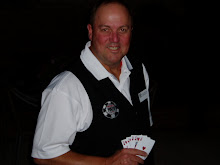
What a treat to deal the 7 Card Stud High-Low tournament. I deal so much Texas Hold'em that it really was a refreshing change to deal a 7 Card Stud game. It seems I also got the poker celebrity table. Occassionally, I will get a well known poker player at my table when dealing a tournament but last night my initial table had three players that have been frequently seen on my television screen: Cyndy Violette, Annie Duke and Berry Johnston (pictured above) were in my seats 1, 2 and 4. All three have won WSOP Bracelets and Berry has five including the 1985 Main Event. They have all been profiled in ESPN World Series broadcasts and been seen on NBC's Poker After Dark.


Both Cyndy and Annie have in the past been credited with having won the largest prize ever by a woman playing poker.


It was actually a really fun table to deal. The mood was pretty light as Annie seemed delighted to be seated next to Cyndy. While Cyndy smiled and nodded, Annie provided a monologue of her recent activities and opinions and both seemed to be really enjoying sitting next to one another. Annie was also my dealer coach. Nothing gets past her as she seemed to count the change and the antes every hand and sometimes directed the action prompting Berry to start needling her.


Annie also had a special request. One of the duties of a dealer in split pot games is to stack the pot during the hand to facilitate the split once the hand is complete. Annie, in the 1 seat, asked that I not stack the pot whenever she was in a hand because it made it difficult for her to see the other players - especially those in the 7 and 8 seats. It was okay for me to stack the pot and speed up play for all the other hands, but if she was involved in a hand, I could worry about splitting it later. Not an unreasonable request. I know that I dislike playing from the 1 seat because of the restricted view.


After a while our entire table, dealer and all, was moved from the Amazon room to the Brazilia room where the main body of players for the tournament was located. I was then pushed on and made my way dealing down the row of tables with no other celebs to amuse me.


Checking the results on the WSOP web site I see that as of the end of day one, Berry and Cyndy are hanging in there with average stacks of around 7,000 but Annie is no longer on the board.


Results of all the tournaments can be found at worldseriesof poker.com.


Wednesday, June 25, 2008

Desert Golf


Portrait of Dan, half my age but still my poker guru, instructor, friend and now Dealer Coordinator. Law school will be taking Dan's career in a new direction soon.

Rio Secco Golf Club is situated high in the hills overlooking the Las Vegas Strip. It is where Butch Harmon has his golf school and where Tiger Woods once honed his game. Tiger's course record scores are printed hole by hole on the scorecard. Employees of Harrah's get to play it for a deeply discounted employee rate, but tee times are limited to late afternoon, the hottest part of the day. Our daytime high temperature was 104 degrees. The course was beautiful but it was hot. In the middle of the round I think I was getting a touch of heat stroke and my game fell apart. I wasn't as worried about missing fairways as I was about my rapid heartbeat and feeling a bit dizzy. It is no wonder that we were the only ones out there. I had two bottles of water and a quart and a half of Gatorade and was still getting dehydrated.

Despite all that I played some good golf in spurts. After the sun lost its sting I was able to birdie the spectacular 18th hole, my second bird of the day. Someplace along the way I also made an eleven, but we failed to calculate a grand total at the end. Dan and I were playing match play and he had me four down by the turn. Blue Moons are on me!

Tuesday, June 24, 2008

PLO Celeb Dealing


The game is Pot Limit Omaha. A.K.A. PLO. The initial stakes are seemingly innocent with a small blind of $25 and a big blind of $50 but this game sweetens the pot with a mandatory "Straddle" ( Blind raise) of $100 on the button. The action in this game, on Table #32 Red is the biggest in the Amazon Room. And there are no other rooms with cash games like this at the Rio. Hundred dollar bills are strapped into $5000 wads sometimes held together with rubber bands. Easier to deal with are the $1000 and $5000 chips from the Rio. Bellagio's $5000 and $10,000 chips are also universally accepted at this table.
Pictured above are three of the more recognizable poker professionals. All World Series of Poker Bracelet winners: David "Devilfish" Ulliot, David Williams and Nenad Medic. They were all at the table when yours truly, the rookie dealer, stepped into the box last night. The first words heard were from Ulliot on my immediate left asking if I had ever dealt Pot Limit Omaha before because, "We can call the floor and get another dealer if you want."
I told him, "I'd like the challenge. I'll give it a go." After all, I dealt it twice last week.
The challenge of dealing PLO is that the bets and raises are determined by the size of the pot. The dealer is supposed to be keeping track to be able to tell players what the maximum bets and raises are. Here is an example from last night:
After an initial raise to $300 and a re-raise to $600 there are three callers. The blinds have folded. I put out the three card flop and Ulliot asks me, "How much in the pot?"
I respond, "Twenty four Seventy-five, call it twenty-five hundred."
Devilfish pushes a stack of 25 black and purple $100 chips forward, cutting them neatly into five stacks of five chips each. Two players fold and David Williams, after checking how much Ulliot was playing (i.e. how much he had left) raises to $5000 and Ulliot responds with "Raise the Pot" which would be a call of $5000 plus a raise of $15,000 (the then size of the pot) but before any chips are moved, Williams folds and I push the pot to David Ulliot.
On it went all night. Thousands of dollars go back and forth for which the Rio collects precisely $72 per half hour. The $8 per player is usually paid by one player who is reimbursed by whoever wins the next pot. Some of the players bristle at this because they want the dealer to just wait and take the payment directly out of the next pot, but we have been instructed to follow the procedure and deal with irritated players. Such is life in the Amazon Room.
Dealing PLO for the big names was pretty cool and now if anyone asks me if I can deal Pot Limit Omaha I can tell them that I've dealt it for some of the biggest players in Vegas.

Sunday, June 22, 2008

Lack of work


This is a problem I didn't think I would encounter during my tour as a dealer at the Series. Lack of work. While there are more poker tables filled with players than anyone has ever seen anywhere, they have hired more than enough dealers to handle it. Case in point was last night. I got to work at six and my first assignment for the $1500 Hold'em tournament that began at noon was to go on break until 6:55 then push into the tournament. When I got there, the players had left for their 90 minute dinner break, so my job was to sit at the table and guard the players' chips. Two tables of guard duty, another break and the players returned. I came back from my break and dealt about five or six hands and my table got broken. This meant that I didn't have a table to deal. Checking with the Dealer Coordinator, there was no other work for me. I was given an "Early out".

Note: Breaking tables - in a tournament, as players bust out throughout the tournament, their seats are filled by breaking a table at the end and sending all of the players from that table to fill the empty seats all around the tournament. That way, the tables melt down to the ultimate single "Final Table" in an orderly fashion. A dealer at a table that is broken is taken out of the rotation and reassigned if there is work available.

What to do? I've only been at work for a few hours and my housemate is in the same situation. We decided to go home, change clothes and go play Poker at the Orleans Casino. We had heard rumors that they have a pretty lively Poker Room over there and figured to give it a shot. We played $1 - $2 No Limit Hold'em at different tables. Interestingly, we both had similar nights, getting down over a hundred and then playing the rest of the night to claw back to even and walk away with a small profit for the evening. Breakfast at Denny's at 2 AM.

Thursday, June 19, 2008

Oops! Got myself in trouble!


All right. Here's my story and I'm sticking to it.

I pushed into table #37, an Omaha High-Low (Eight or better) $10-$20 game with a $15 kill (i.e. the stakes go up if a player scoops a big pot.) Omaha is a notoriously difficult game to deal. OK, it's not all that difficult for an experienced dealer, but for us rookies, there is a lot going on. You have to count the well when you get to the table, make change and take a $4 rake every hand during the play of the hand and stack the pot (with your one free hand) every hand because High-Low means that the highest hand gets half the pot and the lowest hand gets half the pot. Because each player is dealt four cards it is also possible that one player can make both the highest and the lowest hands using different combinations of cards from their hand and the board. All this means is that as a dealer, there is a lot to do and a lot to think about. Easy for a veteran, somewhat tougher for a rookie.

The other problem for us rookies is that sometimes players get a little testy because they want the game to go fast, especially if they are the kind of player that uses a tight strategy to make money at the game. A tight player only plays the best starting hands and plays them very aggressively with the idea that they will push their edge, and make money because they'll win big pots and just fold away the rest of them. Because they only play one out of five or six hands, they often "encourage" the dealer to move the game along as they fold and fold awaiting a good starting hand.

Last night, when I arrived at table #37, the previous dealer had left the well a mess. Typically, the chips in the well are neatly organized. Chips are counted in stacks of twenty and plastic spacers called "lammers" are used to separate the stacks. This makes it easy to count. A stack of white chips is twenty dollars, a stack of blue - forty and a stack of red is a hundred. This well was a mess. On the left was a big stack of 50 or 60 white chips, there were two partial stacks of blue and the reds were uneven. The dealer is responsible for the money. Dealers have to make up shortages out of their pocket and can be terminated if their well is found consistently short.

So I sat down and dug in my heels because I knew it was going to take a few minutes to straighten this out. The player in seat 8 was impatient. "Come on, deal!" "Let's go." "What are you doing dealer? Let's get the cards out." His harassment made me want to take even greater care straightening out this well. I lammered off the chips and got it where there was only a single "working" stack of white, blue and red chips and then counted them quickly and seeing that they were right (or maybe two dollars over). His harassment continued. Although he folded four out of five hands he followed all the action. "Stack that pot up." "Come on." "Let's go" "That's it, split 'em up. Do it!" "Wait! - No! - He get's half the low. Come on dealer, split 'em up!" "What's the problem?" "DEAL."

He finally plays a hand at the end of my half hour session. It is a big one. It is raised and re-raised before and after the flop with four players in it. It was likely the largest pot of my session. The board read 5-6-K-J-9 with all four suits showing. The lady in seat 3 shows her cards and declares, "Straight!" with a proud smile. She held a 7 and an 8 in her hand. Two others mucked but seat 8 just sat and stared at his cards. Then he stared at the board, shaking his head seemingly trying to figure out where he went wrong. Still shaking his head he slowly stood up putting his hand over his cards and stared at the board some more. Then he picked up his cards again, looked at them and showed them to someone standing behind him, said something and then turned back to the game, looked at the board and stared at his cards. Everybody at the table was rolling their eyes and shaking their head waiting for him to show or muck his cards.

"They're not gonna change." said the dealer.

Oops. That's not really the right thing to say in this situation. That's a smart-ass comment from an irritated dealer giving back a little needle to a guy who he thinks might have deserved it.

He erupted into a tirade. I didn't really listen to what he was saying. I just worked on getting this huge pot pushed over to the winner, collecting the cards and setting up to leave the table. "New dealer coming in! Thank you all for your tokes and good luck to everybody."

After I moved to the next table where I had to again straighten out a well that was a wreck, I was relieved early by a dealer telling me that I needed to go talk to the Dealer Coordinator i.e. the boss. Oops.

"What happened?"

After telling my story, he assured me that I had not handled the situation in the best manner and that I should not let it happen again. He gave me the option to leave or to deal some more at another table, but it was after 1 AM and I had been there since 6. I took the option to clock out.

Best Dressed


They say you'll see all kinds at the poker table. They are correct. Tee shirts, sweat shirts and occassionally, a flowing cocktail dress looking elegantly chic at the table.

I could't really get a good photo, but trust me, she was wearing a very pretty dress. I couldn't tell you if she was winning, but she seemed to be spending a good deal of time counting her chips.

John Phan wins the $3k No Limit


Some of the events, make that most of the events are not recorded or televised by ESPN. The grandstand area is not used and the final table is one of the many tables used in the sea of poker in the Amazon Room in the Rio's Convention Center. One of the few cameras around for this final table was my cell phone (which I am not supposed to use while in uniform).
I finished my tour about 1:30 AM and noticed a crowd around the Green table section. It was the final of the $3000 No Limit Hold'em event. The final two players, John Phan and Jonny Neckar had been playing heads up for over six hours. This is very unusual. Yes, heads up for the title takes much longer than it seems on TV, but six hours is a very long heads up battle. The players were getting a little punchy. John Phan had convinced Johnny Neckar to play the next hand "All in blind" and Neckar agreed. Phan had more chips and therefore less to lose because if Neckar loses, he is busted, loses the title and takes second place money. Neckar wins and takes over the chip lead. Again they play a hand betting all the chips without looking at their cards. All the chips go in the middle, the cards are turned face up, then the dealer puts out the Flop, Turn and River cards to decide the winner. Phan wins and regains the chip lead. The third time they decide to play "No Peek" and go All In, see the Flop, Turn and River, then look at their cards, squeezing them out and turning them up one at a time. Neckar wins and the chip count is back to nearly exactly what it was three hands ago.
At this point I am standing on a chair trying to get a view of the table to see these guys apparently tossing a coin for the $160,000 difference between first and second place. That's when I got this picture, just about when I heard the announcer say that the players were going to go back to playing poker. Two hands later, all the money went in and John Phan came out the winner with a World Series of Poker Bracelet and $434,789. Johnny Neckar won $277, 452. You will never see this one on ESPN.