Saturday, March 31, 2012

Event #1 at WSOP Council Bluffs

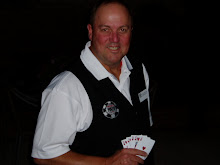
Brent Glantz
"Hey Buz!  Instead of going on break, I need you to push into Table 19.  It's that final table up front."

Event #1, a $350 buy-in tournament that began the day before with 355 entrants and a total prize pool of $103,305 had worked its way down to the final two players, Brent Glantz and Michael Nellis.  The table was set up at the front of the Horseshoe's Whiskey Roadhouse which is normally a bar and restaurant but now our WSOP Circuit Tournament venue.  The table is set up for live streaming video with one camera on the cards and another viewing a wide shot of the players at the table.

I dealt for about a half an hour pushing small pots back and forth when Brent broke through and won a sizable pot from Michael.  The very next hand Brent raised and Michael re-raised all in.  After a long deliberation, Brent called the bet.  Michael showed Ace-Queen off suit and Brent tabled a 9-8 suited in diamonds.  I put out the flop.  A Queen in the door had Michael screaming, "Yes! Yes!"  But then he realized that the next two cards were a nine and another  nine.  "Nooooo.." he groaned.  The Turn and River cards did not produce the Queen Michael was begging for and Brent captured the title with his Three-of-a-kind Nines.

For his excellent play and good luck, Brent received $23,764 and the champion's solid gold WSOP ring provided by the WSOP sponsors.

While this was not my first final table, I dealt finals before at the WSOP and at several circuit events, this was the first time I had ever dealt the absolute final hand of a major tournament ring event or bracelet event.

Thursday, March 29, 2012

Council Bluffs, Iowa WSOP Circuit Event

Bike Night at the Quaker Steak 'n Lube.  50 or 60 Harleys and a few odd others like Indians, Victorys or Hondas.  Bunches of people outside, but tables available inside.  Hmmm.  Doesn't say much about the food.

We completed our work back in Lawrenceburg and headed out to Iowa.  Thinking it was a long drive, we figured on stopping about halfway in Peoria and completing the journey after a brief respite in some Peoria night stop.  Thanks to the beauty of AT&T's 3G we found some highly rated Lamb Chops at Jim's Steakhouse in Peoria which we thought a grand reward for successful completion of the Tri-State Poker event.  They were delicious and the place was old time luxury in the basement of a bunch of downtown Peoria law offices.  Onthe Internet, Barry found the Par-a-Dice Hotel and Casino just off the highway and found it had a Poker Room, so without checking in, we checked out the Poker Room.  There were two tables playing $1-$2 No Limit Hold'em and a tournament was starting up in a while which would draw more players.  Rather than napping, we played for a few hours.  We lost, but it wasn't due to being tired.  Just some unfortunate cards.  Twice I flopped a hidden three-of-a-kind top set and after all the money went in my opponent had made a hand and the board just wouldn't pair for me.  Once versus a straight, the second time versus a flush.

The Floor Supervisor checked the hotel and found that it was full.  Oops.  All the surrounding hotels were full.  We needed to drive about a half hour toward our destination in order to find a Sleep Inn along the way with available rooms.  By the time we got there Barry was napping and I was feeling good so I drove a couple hours, then Barry woke up and drove a few hours while I napped, and back to me about 70 miles from Omaha and onto the hotel.  We called and they said an early check-in would be no charge because they had rooms ready, so we were all set.

Monday, March 19, 2012

Chopping

  Often in smaller tournaments, when there is no obvious chip leader and it is getting down to the final table, players will start considering a chop.  In tournaments, most of the money is concentrated in the first few places.  If there are, say, seven players left in the field it frequently works out that in order to beat chopping the remaining money seven ways, a player would have to take second or third place in the tournament.  Consider this payout schedule from an earlier tournament:

1st $56,861
2nd $35,144
3rd $23,022
4th $15,937
5th $11,623
6th $8,907
7th $7,156
8th $6,017
9th $5,281
With seven players left in the tournament, chopping gives each player a payout of $22,664, and to beat that, a player would have to take third, and then beat it by only $358.

Another consideration was brought up at the final table of yesterday's Senior's event.  The numbers were smaller than the above example and a seven way chop was $4800.  In an interesting twist, one player considered the tax effect.  If you cash in a tournament for over $5000 the casino is required to report the winnings on a 1099-G and winnings from gambling are taxed at the rate of regular income.  So for somebody in the 30% tax bracket, $4800 is $4800 but $5000 turns into $3500.  Even $6000 is only $4200 net after taxes.  Something to think about.

Another thing was what to do about the bubble.  In the Senior's event 35 people get paid.  When there are 36 people left in the tournament, the next player out is the bubble and gets no money.  This means that people play very carefully (and slowly) at this point in the tournament.  All tables play one hand and do not start the next hand until all tables complete the current hand - that way it can be more correctly determined who was the next player to bust.  The problem it causes is that nobody wants to play as they all wait for the next person to burst the bubble and everybody remaining gets paid.  To encourage people to play, all 36 players agreed to put ten bucks in for the "Bubble Boy".  That way, the "Bubble Boy" had already busted and the player who busted 36th got the $360.  The joke was, 35th place only paid $340.  A player busted out 36th on the very next hand. :-)

The King of Hearts is known as "The Suicide King" because of the way he is depicted in most decks as having a sword in his head.  His tendency to show up at the most morbid of times was never more evident than in a hand I dealt the other day where Pocket Aces were up against Pocket Kings.  Both an ace and a king showed up on the Flop and when the odd card, a seven, paired on the Turn both players had Full Houses and all the money went in.  The Suicide King appeared on the River to make Four-of-a-Kind Kings and knock the Aces Full owner out of the tournament.  He was not happy.  At least he got his money in with the best of it and he'll have a good story to tell when someone asks how he did in that big Poker tournament the other day.

Wednesday, March 14, 2012

Tri-State Poker Championships

Eleven days, fourteen events.  The tournaments have buy-ins from $235 to $1600.  Drove up from Tampa with my buddy Barry - former actor, computer tech support, skydive instructor, poker player and current professional poker dealer.  We took the new Mustang.  Conveniently, I-75 runs from Tampa up through Georgia, Tennessee and Kentucky, directly to Cincinnati, just across the Ohio River from the new Hollywood Casino.  Hard to get lost when all you need to do is stay on I-75.  Not a difficult drive with good weather and alternating drivers.
While the check-in was pretty smooth and seamless when we worked the Chicago event, we were considered "vendor employees" at the Horseshoe.  At the last minute our managers discovered that the Hollywood decided they wanted a little tighter security and required that each of us get valid Indiana gaming licenses.  Makes check-in a little more hassle.  Forms to fill out, HR processes to go through, drug test, and we actually have to apply for a gaming license through the casino's HR department. Getting started here is a little more difficult.  While things were really smooth in Chicago, the same management crew is having a little more trouble this time around.
Woody Allen once said, "80% of success in life is just showing up."  What makes it a lot easier is when management lets everybody know with certainty when and where they need to be.  They've been having a little trouble with that this time around.  It is a new venue for this team.  I'm sure they'll get it together.

The challenge the casino has is that they while they would like to put on a big splashy poker tournament and get hundreds of players to show up at their casino, they don't have enough Poker Dealers to handle it.  Steve and Charlie to the rescue!  They contract with casinos all over to provide a crew of dealers to work the events.  They support the World Series of Poker (WSOP) and the World Poker Tour (WPT) as well as other regional events like this one.  Depending on the gaming laws in each state and the requirements of each casino hosting the event, the dealers might be independent contractors, vendor staff or direct employees of the casino.  To deal the tournaments, dealers may or may not need a gaming license from the state, but if they want dealers to handle cash or deal any cash games outside of the tournamens, the license is required.

The different combinations are interesting.  When I worked New Orleans, we were paid as independent contractors rather than employees, but we still needed to get a Louisiana gaming license to deal.  In Chicago, we didn't need the license but were Horseshoe employees and were restricted to dealing the tournaments.  We couldn't handle cash or cash value casino chips.  For Iowa, we have been told that we will get a license and simply be added to the current dealer crew and take shifts at the cash tables as well as the tournaments.  Now here at Lawrenceburg, we have gone through the Penn National Gaming HR support process and are regular, temporary casino employees.  Later today we will complete the gaming license process.  That will free us of the restrictions of non-gaming employees and allow us to deal any table in the casino.  No word yet on whether we'll take advantage of that.  Cash games are nice because you usually get to keep your own tips.  We'll see how it all plays out.

Monday, March 5, 2012

No longer a "rookie" dealer putting out the river card at the 2012 Chicago Poker Classic. 

Monday, October 24, 2011

Dennis Phillips

Dennis Phillips is a professional poker player from the St. Louis area.  He wasn't always just a poker player.  He worked as a manager at a trucking company when in 2008 he made the final table of the World Series of Poker.  He finished third in that event taking home $4.5 million and changing his life forever.

Dennis plays a tight, aggressive, old school style of poker typical of many of the grinders seen on the circuit.  He plays his big pairs and strong aces for raises up front and the speculative hands in late position if he can see a cheap flop.  This style makes it hard to take any chips off of him but carries him deep into most of the events he plays.  As expected, this style has won him a lot of money but coming into Chicago, Dennis has never won a ring or a bracelet at a WSOP event.

Thursday was "Satellite Day" at the Horseshoe.  Satellites are tournaments that pay out in entries or seats to another, higher buy-in tournament.  The Main Event at the Horseshoe will have a $1,600 entry fee.  The honest way a player gets into such an event is not to just plunk down sixteen hundred bucks but to win your way in.  For $150 you can win a seat in the $1,600 event the next day.  The way the "Mega" satellite tournaments work is that once the prize pool has been established, the number of seats can be determined.  For example: After the rake and the dealer tokes have been deducted from the entry fees there might be $17,000 in the total prize pool.  Ten seats would be the prize with the player finishing 11th getting the remaining $1000 in cash.

In the Mega Satellites for the Main Event three seats were added by the house at each one.  The house was giving the players back much of the rake taken in at the entry fees.  It makes the satellites an attractive value playing "juice free".

The 9 pm $150 Mega was also a rebuy tournament.  Players start with 4000 chips and if they fall below 2000 they can buy another 2000 for $100 or if they bust out they can buy 4000 for $200.  At the end of the rebuy period, after the first six twenty minute levels, players can add 2000 or 4000 to their stack as an add-on for $100 per 2000 chips.  All of the rebuy money is added to the prize pool with no rake for the house, however, their is still a 3% toke taken out for "dealers and staff".  By the time the players came back from the 11 pm break, the announcement came out that 17 seats would be available. 

This mega satellite tournament was small enough that all of the tables fit on the stage of the Venue leaving enough room for the final table arena encircled with gold ropes and monitored by an internet web camera suspended above the table.

I pushed into the separate $1,100 final table just before the mega satellite was finishing up.  When they got to their final seventeen the tournament abruptly ended and the stage was empty except for this final table of the $1,100 tournament that had begun the day before.  Dennis Phillips had made the final table despite feeling ill all day.  By this time there were only three players left, each with a mound of chips in front of them.  When Gordon Vayo busted the third player, he had about a 2 to 1 chip lead on Dennis.  The blinds were up to 15,000 and 30,000 with a 5000 chip ante but with over 3 million in chips between the two of them, they could still play some small ball.  And they did.  Back and forth went the blinds and antes.  Shuffle, shuffle, box, shuffle, deal, raise, fold, repeat.  Occasionally, a call.  Put out a flop. Bet. Fold. Over and over.  Gordon and Dennis grinding it out.  30 minutes I dealt, then a 30 minute break while Jason dealt. 30 minutes on, 30 minutes off.  Shuffle, shuffle, box, shuffle, deal, raise, fold, repeat.  During one break I straightened all the chairs and tables on the stage, bussed tables and picked up all the trash.  30 minutes on, 30 minutes off. Shuffle, shuffle, box, shuffle, deal, raise, fold, repeat.  This was going to take a while.

A few hours into it, Dennis says, "You know how this is going to end.  One of us is going to have a pair against a big ace and it's all going in."  About two hands later, just that happened.  Raise. Re-raise. "I'm all in."  Think, think, think, ... ..."I call."

Dennis turned over two sevens while Gordon showed an Ace and a Jack.  I tried to position the cards so they would show up under the web cam and put out the flop.  Jack in the window followed by a ten and an eight rainbow.  The suits were irrelevant.  With Gordon's big chip lead, Dennis needed another seven for a set or a nine to make the gutshot straight.  The Turn card was a four.  No help.  The River brought the nine.  Straight.  Kill the Jacks.  Dennis starting pushing stacks of chips forward.  I was momentarily confused but then, oh yeah, I gotta count all those chips.  There were over a million in stacks of powder blue 25,000 chips and blaze orange 5,000 chips.  The count was verified by Jeremy, the Floor Supervisor, and then Gordon counted out an equal amount from his mound of chips.  It was a complete reversal.  Dennis, once a 2 to 1 dog now held a 2 to 1 chip advantage.

Back to small ball.  30 minutes on, 30 minutes off. Shuffle, shuffle, box, shuffle, deal, raise, fold, repeat.  By 5:30 am with the stacks about the same, Jason dealing, Jeremy and I watching, it went raise, re-raise, all in and call.  This time, Gordon showed the pair, Sixes, while Dennis turned over an Ace and a Queen.  The Sixes never improved but a Queen hit the board and it was all over.  There was just few spectators, Dennis' girlfriend, Jeremy, Jason, the payout person and me.  The rest of the place was empty except the security guards.  According to the media guy, there were 35 people watching the final hand over the internet.

Dennis took home $55,045, a seat in the $1,600 Main Event and a WSOP Circuit gold ring.  He was then taken to the hospital where he was diagnosed with a ruptured appendix.  Rather than playing in the Main Event, he will be recovering from surgery.  I imagine he will still be a happy guy.

Dennis Phillips will forever be able to say he won a WSOP Circuit event and I will be always be able to say I dealt the final table of Dennis Phillips' first WSOP tournament win.

5:30 am. I had started the day at 11:30 am. 18 hours of dealing. I never worked this hard when I was working. So much for an easy retirement.

Sunday, October 23, 2011

WSOP Circuit Chicago

The Venue at The Horseshoe
OK, it's the closest casino to Chicago - The Horseshoe Hammond, IN.  To comply with Indiana gambling laws it is a building built out over the water so that it can technically be a "boat" located on the water.
This is the largest WSOP "Circuit" event of the 17 stops on tour that runs from September 2011 to May 2012.  It is held in "The Venue" which is the Horseshoe Casino's theatre, cleared of theatre seats replaced by 99 poker tables.  There are 12 tournaments that will award WSOP Circuit rings to the winner in addition to prize money as well as daily satellite tournaments and nightly non-ring tournaments.
Event #1 was $350 entry fee with $500,000 guaranteed prize pool with day 1 of the tournament spread over two days to accommodate all of the entries.  There was a fantastic turnout with 1392 entries on the first "Day 1" and an additional 1609 on "Day 1B" for a total of 3001 entries, the largest field ever at a WSOP Circuit event.  Something like 500 of the entries on 1B were people who busted out 1A and were allowed to re-enter as a new player on 1B.  The place was packed.  86 Circuit dealers were augmented by local "House" dealers to fill all of the tables in The Venue plus a share of tables set up in Horseshoe's Poker room.

For dealers looking for work, this is the place to be.  There are daily tournaments at noon, five and seven along with Mega-satellites and single table satellites running throughout the days.  Many of the tournaments are two day events with the first and last being three and four days.  We are scheduled to work every day of the event with no days off.  One shift.  Start at 11 each day and work until no longer needed, generally getting cut between 9 pm and 2 am.  One day I worked until 5:30 am.

It will be interesting to see how the pay works out.  Dealers are paid minimum wage plus dealer tokes.  The toke rate is determined by the number of tournament entries.  3% of each prize pool is held out for dealers and other tournament staff.  The dealer share, plus any tips left by winners, is divided by the dealers according to how many hours were worked.  We should do quite well because the pool of funds is being shared by a small group of dealers working ten, twelve or more hours a day rather than spreading it out over a larger group working more standard eight hour days.  The total number of hours it takes to deal a tournament will be the same, but at this event, those hours are being worked by fewer dealers than I have seen in the past.  This is a good thing.  Nearly all of the dealers are here from out of town and have little else to do but work.  May as well make money instead of reading a book in the hotel room.

More later...