Saturday, July 2, 2016

An Unusually Good Run of Cards


     "...in order for him to make money in this game, he's going to need an unusually good run of cards."  

          - Commentator on High Stakes Poker

Having been scheduled for the 1 PM shift and with nothing to do in the morning I decided to arrive a few hours early and play a little cash game. The "Live Action" cash games at WSOP run 24-7 throughout the series. 

I bought into the $1-$3 No Limit Hold'em game for $300 with my typical stack configuration of $280 in red $5 chips and a $20 in white $1 chips. There were two seats open at the nine handed table. I chose the seven seat. Almost immediately, another player sat down in the five seat with two stacks of red chips. The second hand I saw was 7-7.  I called a raise from the new player and we saw a flop that made both of us happy:  7♠️4❤️A❤️. Bet. Raise. Re-raise. All in. Call. 

Dealer put out the Turn and River. 

"Set of sevens."

"That's good." He threw his hand away and left table. 

A few minutes later a player, an older gentleman wearing a big black cowboy hat, sat down in the that same five seat and placed 12 green and white striped $25 chips in front of him. I sold him a $100 stack of red chips to get him started. And start he did opening up the first hand he saw with a raise. 

I called that raise and flopped a set of fives. He bet the queen high board and I called.  Another queen hit on the Turn. He bet. I raised and he went, "All in."

I said, "I have to call.  I have a Full House."

He replied, "I guess it don't much matter if a make this Straight."  Then he smiled, shook his head and reloaded with another handful of green chips. 

After a dealer change and a bunch of small pot wins and losses, I limped in with 8❤️7❤️ on the button along with several others. Flop came 7-7-2 and the table checked around to me. I bet $5 and got calls from both the Small and Big Blinds. A 9♦️ fell on the Turn. Check.  Check.  I bet $10.  The Small Blind folded, but the Big Blind called. 

I was suspicious. 

After the River card came 5♣️ and my opponent checked, I cautiously checked behind and showed my trips. He mucked. 

Then the Asian player next to me, who had been in the small blind, said, "Good thing you bet $10 on Turn or I beat you with 55."

Whew!

A few hands later, I raised holding JJ and after flopping a set of Jacks and getting no action, I took down another pot. 

After an orbit and another dealer change it was getting late and closer to the time for me to report to work.  I decided to gamble a little. I straddled on-the-button. 

A Straddle is a raise made "in the dark" i.e. before the cards are dealt. At the WSOP cash tables, a player can make this bet either from the under-the-gun position just left of the Blinds or when on-the-button.  It is not generally considered a good bet, but it does create action and raises the level of the game. 

I looked at my cards one at a time.  The first one was good. A black ace. Then I looked at the other. A black ace. Then, thinking I accidentally looked at the same card twice, looked back at the first. A black ace. Then I looked at both at the same time, just to make sure. Two black aces. Is that a tell?

By the time the action got around to me, four players had called the $6. I made it $22 to go and got two callers. 

The flop came with a red ace and all I could see was ♠️and♠️on the other two cards, so when my opponents checked to me I lead out $60 and took down the pot without opposition. 

A few folded hands later it was time to go to work. I made more money in that ninety minutes than I would make in the entire day dealing. Four sets and trip sevens built my stack to over $1000. A good start to the day. 💰😎

Hijinks at the tables

After watching all of these pros play tournaments you would think I could learn that patience is often rewarded and that you just can't waste chips unnecessarily and expect to do well in these contests.  I did not demonstrate those skills in last night's 5 PM Deepstack. 

Wednesday was going to be my first day off after nine days of work, so Tuesday looked like a good day to play a tournament after work. I spent the day dealing the Duece-to-Seven Triple Draw (day 2) and was out when the swing shift showed up.  Timing was such that I could get into the 5 PM late registration (level 4) where I start with 10,000 chips or wait for the 7 PM and start with 5,000 at level 1. I chose the extra 5k. 

Not that I made good use of those chips. In level 6 in middle position I raised with J♠️10♠️, got called by the button with the largest stack and saw a flop of 10♦️9♣️4♥️. I made a continuation bet of about half the pot and got called.  2♦️showed up on the turn and I made another half pot bet which was called. In my mind I planned to bet the river if any card came up that was Jack or smaller and check if anything larger showed up. Irritated when the Q♣️showed up I made an impulsive decision to bluff. Bad choice. My opponent called holding K♥️J♦️ to knock me out with the absolute nuts.  

Note to self: Middle pair is not a good hand to bluff with. It gets calls from hands that beat you and folds from hands you beat. No value in bluffing. The fundamental strategy of betting is to either get opponents with worse to call or get those with better to fold.  

After beating myself up for not playing smarter I decided to try my hand at the cash game and see if I could win back my buy-in. 

Good choice. Got lucky. Called a small raise on the $1-$3 No Limit Hold'em game with 3♠️4♠️ on the button. The raiser was an older woman at the far end of the table having an animated conversation with the player next to her. Another player in the hand asked, "You know him?"

"He speak my language." 

"What language is that?"

"Hebrew."

The World Series of Poker is truly an international event. 

The Flop gave me bottom pair with a 3, so I called her continuation bet. When the Turn added a flush draw for me I thought I could run a little bully bluff against her smallish lead and raised it 3x. Her response was to re-raise her short stack all in with top pair. I called for the small additional amount.

It's always good to have outs when bluffing: Flush on the River. The beauty of No Limit Hold'em. Voilà. Won back my tournament buy-in in one hand at the live action table. 

My pal Barry tells me he wins more against good players because the bad players don't know when to fold. The good players are willing to seriously consider folding a top pair or an over pair when faced with a raise on the Turn. Your typical small stakes cash player has a tough time with that decision. I know. I've gone bust often enough holding something like QQ or KK. 

Famous last words: "Don't go broke with just one pair!"

Wednesday, June 22, 2016

Halfway mark at 2016 WSOP


I have reached the halfway point of the 2016 WSOP having been here for about 3 1/2 weeks with that much to go. There is no shortage of work this year. We have six day work weeks and no shortage of overtime. So far, I have only dealt one final table, the $10,000 Lowball Draw Poker Championship. 
As usual, there is a lot of chirping and hand wringing around the dealer's break room about how much we get paid and what the "down rate" will be. If you're familiar with poker dealers, you understand that every 30 minutes a dealer sits at the table pitching cards equals a "down".  It's the basic poker dealer unit of work. A portion of every poker players entry fee is set aside to pay the dealers. That pool of money is divided by the number of "downs" it took to complete the tournament and each dealer gets paid for the number of downs they worked. Hence, the angst over the "down rate".  
Pleasant surprise for 2016, it seems the down rate will be up from last year. The increase is not because WSOP is taking more out of the player's prize pool, but because the smaller buy-in tournaments are better managed and have a more efficient structure. 
I say they are better managed because we have many fewer dead spreads. Fewer tables with dealers sitting at empty tables, collecting downs at the tournament start waiting for players. I also see fewer tables with multiple empty seats during the first levels of the tournaments. Better, more efficient management of the process of getting the tournament started helps to keep the "down rate" up.
The bigger thing is the tournament structure itself. In the past many of our tournaments began the first level with the blinds at 25 and 25. This year they begin at 25 and 50.  In addition the antes kick in at level 3 whereas in the past they didn't start until level 4.  The change makes the early levels more meaningful for the players.  In other words, it's easier to bust out of the tournament earlier, shrinking the field sooner. The players seem to like it. This is good for us and it seems to be working.  "Down rates" are higher than last year. How do you like that? The players are happy, the dealers are happy and management is happy!


Monday, May 30, 2016

WSOP 2016 Starts this Week!

Orientation was Sunday. The Penn and Teller Theater at the Rio was filled with dealers - and that was only those with last names A-L!  Frank Moreno, headliner at Planet Hollywood stopped by to sing a few songs to kick things off for us and then it was it was the expected mix of rules, things to know and pep talks. We got a pep talk from guest speakers Barry and Allyn Shulman, owners of Card Player Magazine and winners of over $6 million in poker tournament prizes. We were reminded that attitude is "a little thing that makes a big difference" and that the players, generally, are not interested in the dealer's opinion of whatever it is they are discussing. 

So now two days off and then start a six day work week. I guess management figured out that because this is a temporary gig, it is okay to schedule workers for a string of six day work weeks as long as they pay overtime, despite the fact that in the USA the five day work week is standard. For most dealers who have travelled and are paying for housing in Vegas while also paying for housing wherever they travelled from, the six day work week is nice. More money and less time to kill while in Sin City where there are all kinds of ways to spew money. 

Speaking of killing time, with nothing to do but kill time until work starts, I headed over to the Flamingo to play a little $1-$2 No Limit Hold 'em. In typical No Limit fashion I got it in bad and sucked out for a big win. 😎. 

Here's how the hand went:

I had JJ, pocket Jacks, in middle position and raised to $12.  The player next to me, a tourist from Germany, with a large stack made it $25. It folded to the Big Blind who only had $65 total and he put it all in. I figured that if I just called, the German would also and I didn't relish the idea of taking my Jacks against two players but if I re-raised, the German could fold thinking that since I made the fourth raise pre-flop it usually signals Aces .  I thought I also might be able to play an even larger side pot against the German and come out ahead if I lost to the short stack. So I shoved "All In". Since I was obviously trying to isolate the short stack, the German correctly determined that I likely didn't have Aces and since he was holding KK, he wasn't going anywhere, anyhow.

So I said a little prayer to the nonexistent Poker gods for a Jack on the Flop, but it came out K-Q-10 missing my Jacks on both sides and leaving me with an up-n-down straight draw.  After a 4 on the Turn, the River brought an Ace to give me the "Broadway" straight beating both my opponents who were holding AA (the Short Stack) and KK (the German). So I went from about $175 to over $400 one lucky hand. 

According to Barry Shulman's Card Player Magazine Odds Calculator, I was about a 5 to 1 underdog (16% chance to win) in that hand. This is not really a good bet for me as I was only collecting less than 2 to 1 when I win. If I keep making bets like that, it will not be long before I am broke. 

I played about even for the next couple hours and went home with a profit.  

Poker is lots of fun when you get lucky. It's also fun when you can pull off a bluff and steal a pot. Professional poker player Antonio Esfandiari once said, "In poker, over the long term, everybody gets the same hands. The profit is in what you can steal!"

What to do with my Memorial Day holiday?  I hear that Steve Wynn moved and expanded his Poker Room and the new location is now in the Encore next door. I might need to go check it out. 

Tuesday, February 16, 2016

HPT Ameristar East Chicago

We had an excellent tournament at the Heartland Poker Tour's stop in East Chicago January 14 to 25, 2016.  Record breaking crowds nearly overwhelmed the staff.
I knew when I first checked in that we were going to get a lot of work because Ashley in HR told me that she was only able to hire 24 dealers rather than the 30 that Jeremy (HPT Tournament Director) had asked for.
Turns out we did better than expected in terms of turnout. We had the largest Main Event field of any HPT stop outside of Colorado.  Apparently, poker starved Colorado has by far the largest turnout of any HPT sites.
I found that remarkable because Ameristar East Chicago closed its Poker Room and converted it to Baccarat last summer.  They compete with a small poker room at The Majestic and also the Horseshoe Hammond and they have a beautiful Poker room with a large local following.  So even without a poker room Ameristar EC had record breaking turnout and no cash games on the side.  We heard complaints from players, but it didn't stop them from coming.  Seems that if they wanted to play a cash game they just drove over to the Majestic or to the Shoe.
At HPT stops they usually staff the final table on Monday with local dealers and let the travellers go but no poker room, it was staffed from the temporary crew.  I saw this coming and bought by return plane flight for Tuesday in case I got the chance to deal the final TV table - and that is the way it worked out.
The old geezers did the early shift and the ladies took it the rest of the way to the winner.
HPT produces a television show of each tournament and airs the shows on cable channels across the country. Cox cable, here in Arizona doesn't carry it, but I still will be able to see it when it becomes available on the watch.hptpoker.com web site.
I probably won't get on camera too much because most of the time I was dealing there was a camera right over my shoulder focused on the players.  In all it was great fun knowing that we were making a TV show "in front of a live studio audience!"

Tuesday, June 9, 2015

$10,000 entry Razz Final Table

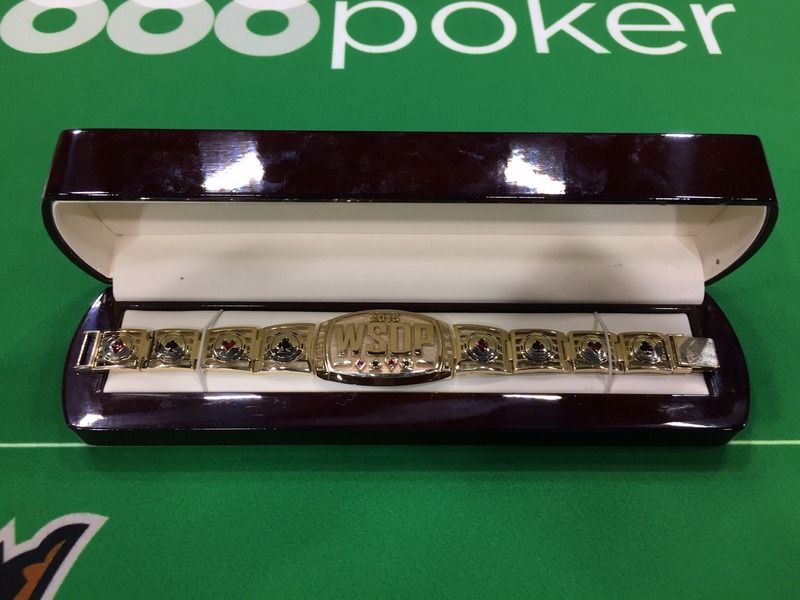
I had the privilege of being one of the three dealers to deal the final table of Event 17, the Razz Championship. It is not only a "Bracelet Event" but it is also considered a "World Championship" as are all events at the WSOP that have a $10,000 entry fee.

The three of us, Eric Green, Shaun Harris and I, began setting up two tables for the last sixteen players at about 1:30 pm and finished up a little after midnight.

What is Razz?  It is a variation of 7-Card Stud lowball. It is dealt like 7-Card Stud but the winning hand is the lowest combination of five cards, the best being A-2-3-4-5-x-x. Straights and Flushes have no bearing on the hand value. Some say it is not really Poker because it does not use the conventional poker rank of hands but the essential elements of poker are there: the ability to win pots with the best hand at showdown and the ability to win by betting to convince your opponent to fold.

We started the day with two tabes in the northeast corner of the Amazon Room. Shaun was on 446, Eric on 449 and I was on first break.  Every half hour we rotate, so we do 30 minutes at 446, 30 minutes on 449 followed by a 30 minute break. We ran this rotation until around 3:30 when the seventh player had busted out losing all of his chips. With 9 players left we took a quick break and moved our table into the Amazon Arena, the stadium like setup where Championship final tables are broadcast live on the Internet, recorded and archived.

Dealers stay in the same rotation but responsibilities change. One dealer is at the table, one acts as a runner assisting the floor and players with whatever is needed and escorting any player busting out to the payout clerk for processing, and the third on break. The difference is that when on a final table, you get paid for all three positions as if you were dealing continuously.

That is the rotation we were in. The extra money isn't really important to me, although I appreciate being fairly compensated for my labor, I get great personal satisfaction from being in the center of the arena, on camera, with a lot on the line and proving to myself that I can perform well under the stress.   On this day, I was quick, accurate, precise and my procedures were by the book right down to clearing my hand after the cut (a procedure many dealers fail to perform). It can be tough. You have an earpiece in your ear with a producer giving some instructions as you deal. There are many spectators in the stadium all watching your moves with multiple video screens showing every action and a set of video cameras with potentially thousands of viewers all around the world watching the game you are running. Seeing that I do this part-time as a hobby rather than for a living, I'm pretty proud of being able to perform in the arena.

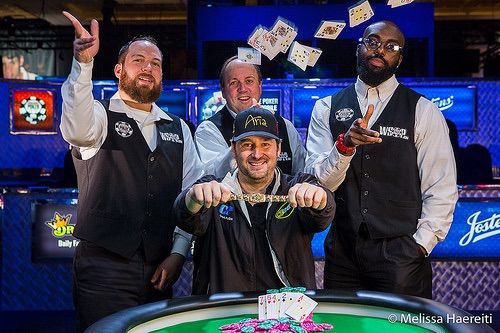
But enough about me. Phil Hellmuth, who has won the Main Event and won more WSOP Bracelets than any other captured his 14th bracelet by winning this 2015 World Championship Razz Event. Eric Green had the privilege of dealing the final winning hand.